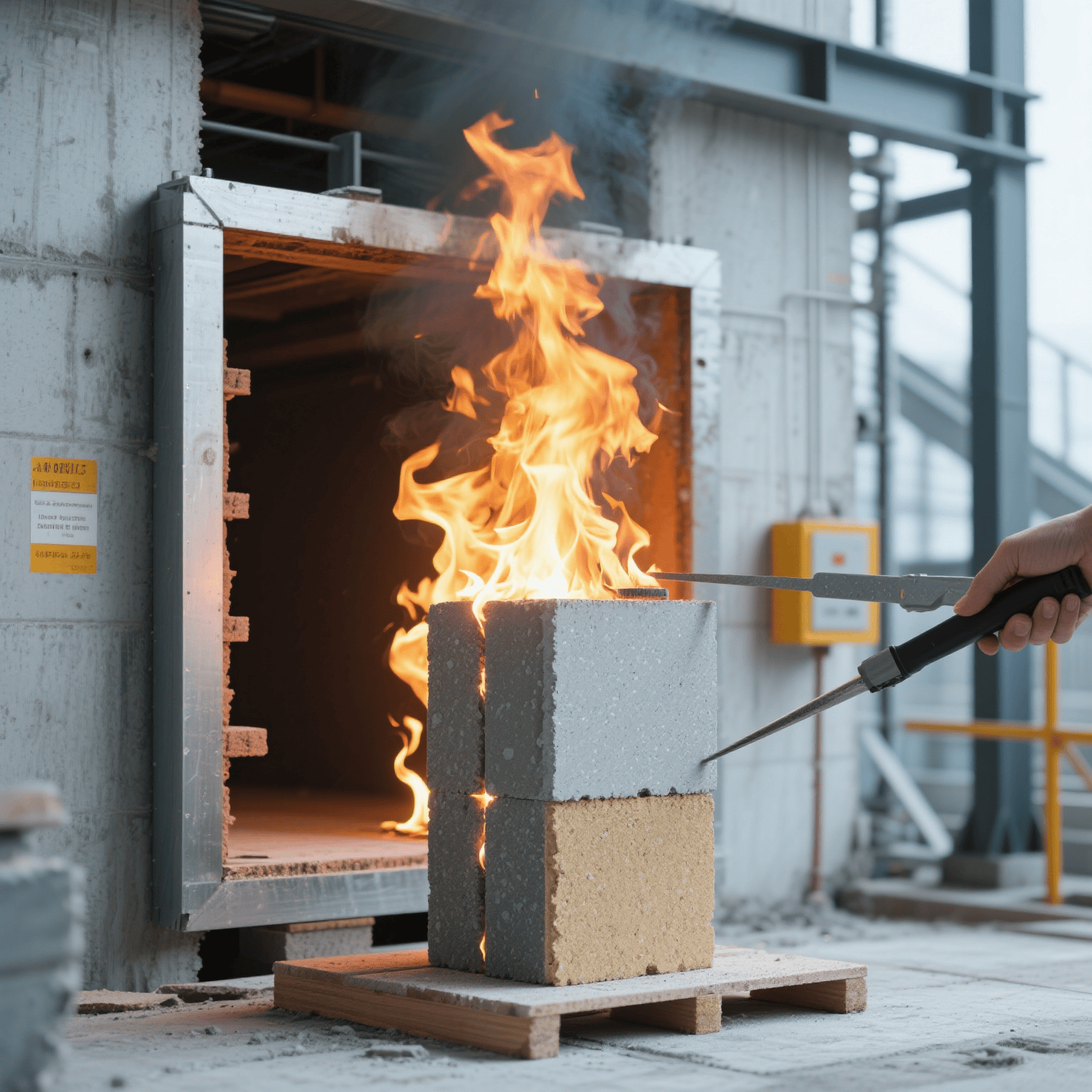
Fire Resistance Testing refers to professional tests for evaluating the capacity of materials, products or building components to resist combustion, slow down flame spread and maintain structural stability under specified high temperature and flame conditions. Widely used in construction, transportation, electronics, textiles and other industries, it is a vital procedure to guarantee public safety and product compliance.
By simulating real fire scenarios, fire resistance testing assesses the following key indicators:
Flame retardancy: Whether the material is hard to ignite or can self-extinguish rapidly after ignition;
Fire resistance rating: The maximum duration for building components (such as walls, floor slabs and fire doors) to retain thermal insulation, integrity and load-bearing capacity during a fire;
Smoke yield and toxicity: The smoke density and emission volume of toxic gases (such as carbon monoxide and cyanide) generated when materials burn;
Flame spread rate: The diffusion speed of flames over material surfaces or between components.
Different standards adopt different classification methods for fire resistance performance, for example:
1. Sample Preparation
Produce representative samples in accordance with standard requirements (for example, fire doors shall include complete assemblies such as door frames, door panels and sealing components), and the dimensions shall comply with the specifications of test equipment.
2. Test Environment Setup
Mount the sample in a test furnace to simulate the temperature curve of real fires (as specified in ISO 834, the temperature rises to 925℃ within 30 minutes and 1090℃ within 120 minutes).
3. Parameter Monitoring
Real-time data shall be recorded throughout the test:
Temperature on the unexposed side of the sample (for heat insulation assessment, generally limited to a maximum of 140℃);
Occurrence of flame penetration or gaps (for integrity assessment);
Structural collapse or loss of load-bearing capacity (for load-bearing performance assessment).
4. Result Evaluation
Determine the fire resistance rating (e.g., 1 hour, 2 hours) based on the time when the sample loses heat insulation, integrity or load-bearing capacity, and issue a test report accordingly.
HWD | HuaWayDa is a comprehensive third-party service institution integrating inspection, testing, metrology, certification, training and enterprise technical services. It consists of Management Center, Marketing & Customer Service Center, Laboratory, Certification Center, Management Institute, Sustainable Development Center and Enterprise Service Center, and is committed to providing customers with professional, efficient and authoritative one-stop enterprise solutions.
HWD | HuaWayDa holds CNCA approval certificate, CMA qualification, measurement standard assessment certificate, CNAS accreditation and other relevant qualifications.
We strive to build long-term and mutually trustful partnerships with clients. We are not merely a service provider for your current projects, but also a reliable think tank and companion on your journey to pursue excellent management.
Choosing us means you are not only selecting a service, but also a long-term partner rooted in professionalism with your success as our mission. We promise to help you build a solid management foundation and sustainable competitive advantages with our professional capabilities.


Tel:021-6409 0330
13917723034
Email:info@huawayda.com