Gas Alarm Device Testing (Toxic, Harmful, Flammable Gas, Oxygen, etc.)

Gas alarm instruments are categorized into three types by detection targets: flammable gas, toxic and harmful gas, and oxygen alarm instruments. All products shall comply with GB 12358-2024 General Technical Requirements for Workplace Ambient Gas Detection and Alarm Instruments. This mandatory national standard was issued on November 28, 2024, and implemented on June 1, 2025.

Flammable gas instruments detect flammable and explosive gases such as methane and hydrogen, with the Lower Explosive Limit (LEL) as the alarm threshold. Toxic and harmful gas instruments detect toxic gases including carbon monoxide and hydrogen sulfide, triggering alarms based on occupational exposure limits. Oxygen instruments monitor atmospheric oxygen concentration with alarms set for oxygen deficiency and oxygen enrichment conditions.

The standard specifies unified requirements for instrument indication error, response time, audible and visual alarm, self-diagnosis of faults, environmental adaptability, electromagnetic compatibility and other indicators. It applies to all types of workplace gas detection and alarm equipment including portable, fixed, pump-suction and diffusion types. Meanwhile, it stipulates that the instrument calibration interval shall not exceed 1 year to guarantee safe and reliable operation.

Gas alarm devices are used for real-time monitoring of flammable and toxic gas concentrations in the environment. They automatically activate audible and visual alarms when concentrations exceed limits, and can interlock with exhaust ventilation systems and gas supply shut-off devices to prevent explosions and poisoning accidents. They are widely applied in industries, catering businesses, laboratories and other scenarios.

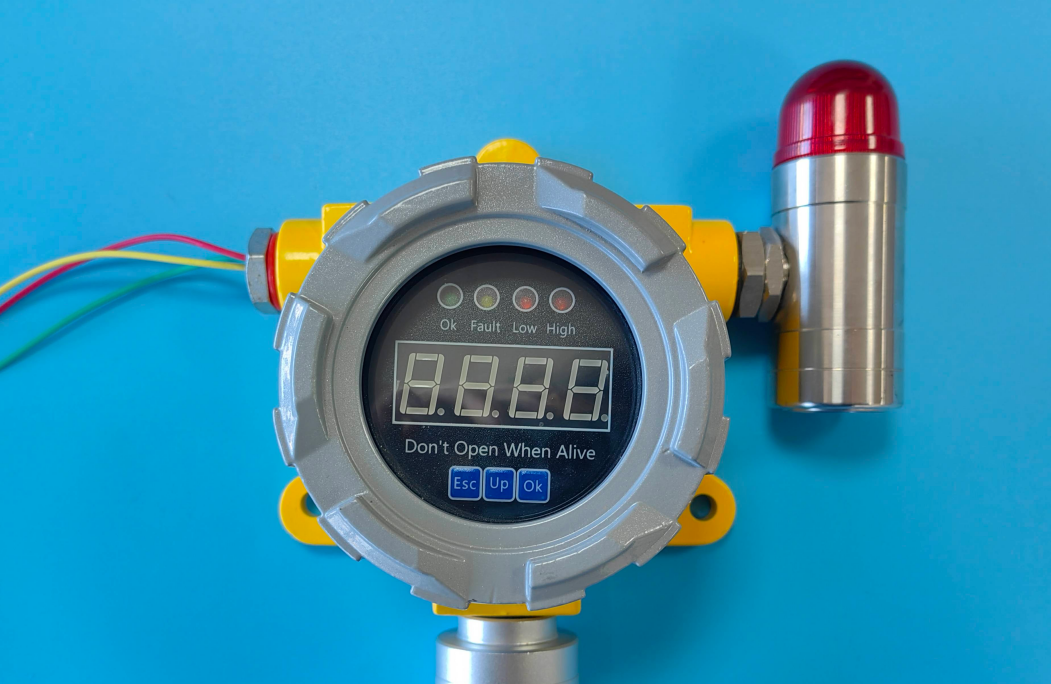
The device mainly consists of detectors and alarm controllers. The detector collects gas signals, while the controller displays concentration readings, triggers alarms and realizes equipment interlocking.

Common Sensor Types:

  • Catalytic Bead: For flammable gas detection, featuring fast response and moderate cost;

  • Electrochemical: For toxic gases such as carbon monoxide and hydrogen sulfide with high measurement accuracy;

  • Infrared: Long service life and anti-poisoning capability, suitable for high-concentration flammable gases and carbon dioxide;

  • Semiconductor: Low-cost, mostly adopted in household applications.

In terms of installation forms, they are divided into fixed type (long-term online monitoring) and portable type (routine inspection and confined space operations). Product selection requires clarification of gas type, explosion-proof grade and installation environment. Products shall conform to national standards and receive regular calibration and maintenance to ensure reliable performance.


Toxic and Harmful Gas Alarm Instrument

Toxic and harmful gas alarm instruments are electronic devices that realize real-time monitoring, quantitative display, and audible/visual/interlock alarm upon concentration over-limit. They are mainly used to detect toxic/hazardous gases such as hydrogen sulfide, carbon monoxide, chlorine, ammonia and VOCs to prevent personnel poisoning, fire and explosion accidents.

They shall comply with national standards GB/T 50493-2019 (Code for Design of Flammable and Toxic Gas Detection and Alarm in Petrochemical Industry) and GB 12358 (General Technical Requirements for Instruments Used in Workplaces).

I. Core Functions:

  1. Real-time concentration display (ppm/ppb/% VOL/% LEL)

  2. Multi-stage alarm (low alarm / high alarm / interlock)

  3. Data logging and remote transmission

  4. Fault self-check (sensor failure, power cut, etc.)

II. Main Classification

  1. Classified by installation/application mode

    • Fixed type (online type): Installed near leakage points and matched with controllers, suitable for 24-hour continuous monitoring; commonly used in chemical plants, tank farms and sewage treatment plants.

Portable / handheld type: Battery-powered, convenient for patrol inspection, confined space operations and emergency detection; available for single gas or multi-gas composite detection (e.g., 4-in-1: O₂ + flammable gas + CO + H₂S).

III. Application Scenarios

  • Chemical / petrochemical industry: Leakage of raw materials/intermediates (such as chlorine, hydrogen sulfide, ammonia);

  • Metallurgy / mining: Underground CO, H₂S and oxygen deficiency;

  • Municipal sewage / waste treatment: H₂S generated in anaerobic tanks;

  • Laboratories / pharmaceutical factories: VOCs from organic solvents;

  • Pre-detection of multiple gases for confined space operations (e.g., storage tank and pipeline maintenance).

IV. Key Points for Model Selection & Installation

  1. Clarify target gases and occupational exposure limits (PC-TWA/PC-STEL) to confirm measuring range and alarm thresholds;

  2. Environmental conditions: Explosion-proof grade (Ex ia/ib/IIB/IIC T4/T6), temperature, humidity and dust;

  3. Installation height: For gases heavier than air (such as H₂S, Cl₂), install 30–60 cm above the ground; for gases lighter than air (such as NH₃, H₂), install 30–60 cm below the roof;

  4. Perform regular calibration (zero point + span) in accordance with regulatory cycles; sensors must be replaced upon expiry.

V. Compliance & Maintenance

  • Must obtain metrological certification and comply with GB 12358 and GB/T 50493;

  • Daily inspection: Power supply, display and alarm functions;

  • Regular calibration (generally once every 6 months);

  • Prevent sensors from long-term exposure to high-concentration toxic/corrosive gases to avoid irreversible damage.

Combustible Gas Alarm Instrument

Combustible gas alarm instrument is safety equipment used for real-time monitoring of the concentration of combustible gases (such as methane, propane, hydrogen, etc.) in the air. When the concentration reaches preset low/high alarm thresholds, it immediately triggers audible, visual, SMS and other alarms. Some models can interlock with exhaust ventilation systems and gas cut-off devices to prevent fire and explosion accidents. They are widely applied in petrochemical industry, coal mines, gas stations, kitchens and other scenarios.

I. Classification and Application Scenarios

  1. Fixed type (online): Permanently installed on site for 24-hour continuous monitoring, consisting of detector, controller, audible & visual alarm and interlock module. Suitable for factory workshops, gas stations, boiler rooms and underground utility tunnels.

  2. Portable / handheld type: Compact and rechargeable, convenient for patrol inspection, hot work and pre-entry detection for confined spaces. Common types include single combustible gas detector and multi-gas composite detector (e.g., 4-in-1: Combustible gas + O₂ + CO + H₂S).

II. Key Technical Indicators and Alarm Classification

  1. Unit: %LEL (percentage of Lower Explosive Limit) is commonly adopted. The primary alarm is generally set at 25% LEL (warning), and the secondary alarm at 50% LEL (interlock shutoff / emergency evacuation);

  2. Response time: Catalytic bead type < 10s; infrared type requires slightly longer time;

  3. Explosion-proof grade: Equipment deployed in industrial sites must comply with explosion-proof standards such as Exd II CT6 to avoid spark-induced ignition;

  4. Calibration cycle: Fixed instruments are calibrated once a year generally, and portable instruments once every six months. Standard gas (such as methane / propane standard gas) shall be used for calibration;

  5. Applicable standards: GB 15322 (Combustible Gas Detectors), GB 12358 (General Technical Requirements for Gas Detection and Alarm Instruments Used in Workplaces), GB/T 50493 (Specification for Design of Combustible Gas and Toxic Gas Detection and Alarm for Petrochemical Industry).

III. Key Points for Model Selection, Installation and Maintenance

  1. Model selection: Select sensors according to gas type, concentration range, ambient temperature, humidity, corrosivity and explosion-proof requirements. Infrared sensors are preferred for highly toxic or sulfur-containing environments. For portable patrol inspection, select models with long battery life and triple alarms of sound, light and vibration;

  2. Installation: Fixed detectors shall be installed at locations prone to gas accumulation (e.g., below gas sources and low-lying areas), within 1m from gas release sources. Installation height depends on gas density: install at upper positions for gases lighter than air, and lower positions for gases heavier than air. Controllers shall be placed in manned control rooms;

  3. Maintenance: Regularly clean the gas inlet to prevent dust blockage; avoid sensor poisoning (do not directly aim lighter flame at the detector); perform calibration on schedule; record alarm history; replace batteries periodically.

IV. Common Misunderstandings and Safety Reminders

  • Do not spray pure lighter gas directly onto the sensor, which will cause permanent damage;

  • Catalytic bead sensors deliver inaccurate readings when oxygen concentration is lower than 10%; infrared sensors shall be adopted in oxygen-deficient environments;

  • Household gas alarms shall be interlocked with shut-off valves, and industrial systems shall be connected to DCS / fire protection systems;

  • Instruments only serve as early warning tools. Safe operation can only be guaranteed when combined with ventilation measures, explosion-proof electrical equipment and emergency response plans.

Oxygen Gas Detector

Oxygen alarm instrument (also known as oxygen detector / oxygen alarm) is safety equipment for real-time monitoring of ambient oxygen volume concentration (% VOL). It triggers audible, visual and vibration alarms when the concentration falls below the lower safety limit (oxygen deficiency) or rises above the upper safety limit (oxygen enrichment). It is widely used in confined spaces, industrial workshops, mines, laboratories and other scenarios.

1. Functions

  • Monitor oxygen concentration in the environment

  • Prevention purposes:

    • Oxygen deficiency: human suffocation, coma and death

    • Oxygen enrichment: supports combustion and greatly increases risks of fire and explosion

2. Measuring Range and Alarm Values (National Standard / General Industry Specifications)

  • Normal atmospheric oxygen level: 20.9% Vol

  • Common measuring range: 0~30% Vol

  • Standard alarm setpoints:

    • Low oxygen alarm: ≤19.5% Vol

    • High oxygen alarm: ≥23.5% Vol

3. Classification

(1) Portable Oxygen Detector

  • Worn and carried by individual workers

  • Mandatory equipment for operations in confined spaces, underground areas, tanks, pipelines and basements

  • Common type: 4-in-1 gas detector (O₂ + LEL + CO + H₂S)

(2) Fixed Oxygen Detector

  • 24-hour online continuous monitoring

  • Installed in control rooms, pump houses, enclosed workshops and laboratories

  • Equipped with controller and audible & visual alarm; capable of interlocking with fans / valves

4. Sensors

Electrochemical oxygen sensors are adopted in almost all devices

  • Advantages: high accuracy, stable performance and fast response

  • Disadvantages: limited service life; replacement is generally required every 1~2 years

5. Scenarios Where Oxygen Detectors Are Mandatory

  • Confined space operations (wells, pools, tanks, enclosures and pipelines)

  • Basements and enclosed factories

  • Laboratories using inert gases such as nitrogen, argon and helium

  • Steelmaking, chemical industry, sewage treatment and mining

  • Oxygen-enriched environments (hyperbaric oxygen chambers, oxygen-enriched welding)

6. Key Safety Knowledge

  • Oxygen deficiency can cause fatal injury faster than poisoning; loss of consciousness may occur within seconds

  • In oxygen-enriched environments, clothes and grease are extremely flammable and prone to explosion

  • Rules for entering confined spaces: conduct detection first, then ventilate, then start work, and keep continuous monitoring throughout operations

Relevant Standards

Implementation Standard GB 12348-2024 General Technical Requirements for Workplace Environmental Gas Detection and Alarm Instruments

FAQ
 
Our Advantages
Authoritative Qualifications

HWD | HuaWayDa is a comprehensive third-party service institution integrating inspection, testing, metrology, certification, training and enterprise technical services. It consists of Management Center, Marketing & Customer Service Center, Laboratory, Certification Center, Management Institute, Sustainable Development Center and Enterprise Service Center, and is committed to providing customers with professional, efficient and authoritative one-stop enterprise solutions.

HWD | HuaWayDa holds CNCA approval certificate, CMA qualification, measurement standard assessment certificate, CNAS accreditation and other relevant qualifications.

We strive to build long-term and mutually trustful partnerships with clients. We are not merely a service provider for your current projects, but also a reliable think tank and companion on your journey to pursue excellent management.

Choosing us means you are not only selecting a service, but also a long-term partner rooted in professionalism with your success as our mission. We promise to help you build a solid management foundation and sustainable competitive advantages with our professional capabilities.

Submit Your Requirements Now
Our expert team delivers premium solutions for you
Related Downloads

Tel:021-6409 0330
         13917723034

Email:info@huawayda.com

© Copyright Huaweida Testing & Certification (Shanghai) Co., Ltd. All Rights Reserved ICP Filing/License No.: 16029900-1