China's Carbon Neutrality Framework. Academician Ding Zhongli: Promote Carbon Neutrality via Three-pronged Approach
The carbon neutrality drive presents both challenges and opportunities, representing a sweeping transformation spanning a wide range of sectors.
Academician Ding Zhongli holds that carbon neutrality, though seemingly intricate, can be summed up as a three-pronged system with efforts exerted on three fronts:
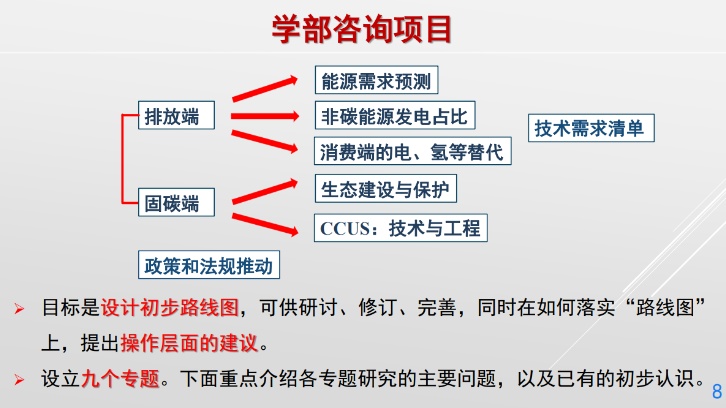
The first front: energy supply. We shall replace fossil fuels with carbon-free energy sources for power generation and hydrogen production to build a new-type power system or energy supply system.
The second front: energy consumption. In most sectors including residential living, transportation, industry, agriculture and construction, carbon-free energies such as electricity, hydrogen, geothermal energy and solar energy shall replace fossil fuels in consumption.
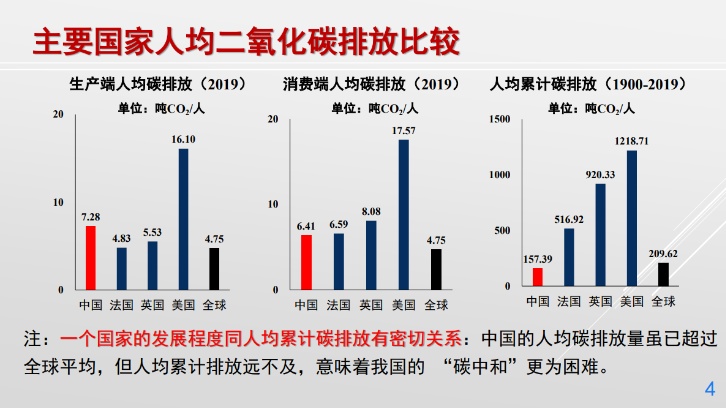
The third front: artificial carbon sequestration. Combined projects including ecological restoration, soil carbon sequestration, carbon capture and storage shall be deployed to eliminate unavoidable carbon dioxide emissions. China’s per capita carbon dioxide emission at the production end stands at 7.28 tons per year, above the global average level. From the consumption perspective, China’s per capita emission is lower than that of the United Kingdom, France and the United States. In terms of cumulative per capita carbon emissions, China’s figure is far below the global average: the global average reaches 209 tons per capita, the United States hits 1,218 tons per capita, while China merely records 157 tons per capita.
How China Achieves Carbon Neutrality
The development of carbon-free energy technologies follows an iterative process. Academician Liu Zhongmin from Dalian Institute of Chemical Physics proposed a three-stage roadmap: the first stage features clean and efficient utilization of fossil fuels coupled with alternative energy deployment; the second stage focuses on complementary and large-scale application of renewable energies; the third stage realizes intelligent multi-energy integration of low-carbon energies. The specific implementation approaches require further in-depth discussion, and this topic will be concluded together with the second special session.
To calculate the future carbon sequestration potential of China’s terrestrial ecosystems, the following core issues need to be addressed:
3. Assessment of Carbon Capture, Utilization and Storage (CCUS) Technologies
02 Viewpoints of Academician Ding Zhongli
First, the carbon neutrality process brings both challenges and opportunities; it will trigger an extensive economic and social transformation covering numerous fields. The state shall conduct proactive research and planning, make systematic arrangements, mobilize competent resources and offer special support. We shall strive to secure industrial dominance through technological advancement, enabling carbon neutrality to serve as a key driving force for national rejuvenation.
Second, delivering this grand transformation requires coordinated efforts on the three fronts of energy mix, energy consumption and artificial carbon sequestration. The capital investment required will reach an astronomical figure, which can never be fully covered by government fiscal subsidies. Market orientation shall be upheld, competition encouraged and steady progress pursued. Government fiscal funds shall be mainly channeled into technological R&D and industrial demonstration projects to accelerate the iterative upgrading of China’s technologies and industries.
Third, only framework proposals can be put forward for discussion, revision and improvement within the scientific community. China’s academic circle should maintain an open attitude, participate extensively and bring imagination and creativity into full play. Relevant national authorities may adopt a period of free academic debate before finalizing the roadmap, and must refrain from rushing to draw premature conclusions or pushing forward relevant policies with excessive haste.
Fourth, coordinated progress across all industries is critical during this transformation. Carbon reduction, carbon sequestration, power substitution and hydrogen energy substitution will all impose additional costs on enterprises. Therefore, sector-specific carbon neutrality roadmaps and effective incentive & constraint mechanisms must be formulated as soon as possible.
Fifth, the carbon neutrality level of a country, region, industry, enterprise or even household shall be measured from both carbon inflow and outflow perspectives. From the energy consumption perspective, carbon outflow (i.e. emissions) is relatively easy to quantify, while carbon inflow (i.e. carbon sequestration) is hard to calculate precisely due to its diverse categories and complex processes. Hence, the state shall establish a systematic standard system for carbon monitoring, accounting, reporting and verification at an early date, so as to secure discourse power regarding China’s carbon budget.